 The Hydrated Gut
How Much Water Should You Drink a Day After 50?
By Raymond Koekemoer · October 5, 2026
Labels used in this article: Tradition what Ayurveda and traditional Chinese practice teach · My experience what I tried and what happened to me · Research what studies and health bodies report. How I check what I publish
For years I chased a number. Eight glasses. Two liters. A bottle that had to be empty by evening. I hit the number most days, and I was still dry, bloated, and constipated.
What I eventually learned is that “how much?” is only a small part of the answer. When you drink, how warm it is, and what it arrives with matter at least as much.
What the old traditions say
Tradition Ayurveda has never given everyone the same quota. Its advice is simpler, and more personal: sip warm water through the day, drink when you are thirsty, and do not force down more than the body is asking for. Too much water, in this view, is as unhelpful to digestion as too little.
Traditional Chinese practice says much the same. Warm water and warm teas, taken steadily, not a flood all at once.
Neither tradition counts glasses. Both watch the person.
Where the famous numbers come from
Research “Eight glasses a day” is repeated everywhere, but it has never been traced to solid evidence. It is a convenient rule of thumb, not a measurement.
Research The official figures are usually misread. Health bodies in the United States and Europe suggest, as a rough adequate intake, something in the region of 2 to 2.7 liters of total water a day for women and 2.5 to 3.7 liters for men. “Total water” includes the water in your food — often a fifth of the total or more — and every drink you have, including tea, coffee, and milk. It is not a target for plain water on top of everything else.
Popular formulas, such as a glass for every waking hour, are ballpark figures for healthy adults. They are not designed for a 70-year-old on blood pressure tablets.
The numbers are a rough guide for an average person. You are not an average. You are you.
Why a single number fits poorly after 50
- Bodies differ. A small woman and a tall man do not need the same amount.
- Food counts. A day of soups, stews, fruit, and porridge brings far more water than a day of toast and crackers.
- Thirst gets quieter with age, so some of us drink too little without noticing.
- Medicines change the picture. Diuretics (“water pills”) and some other medicines affect how the body handles fluid.
- Some conditions call for less, not more. With heart failure or kidney disease, a doctor may set a fluid limit, and that limit comes first.
- More is not always better. Drinking far beyond your needs can dilute the salts in the blood, which is dangerous.
What matters as much as the amount
When. Most of your fluid belongs in the morning and afternoon. A large drink late in the evening mostly means a broken night.
My experience How warm. In my experience, warm water goes in more easily than cold. Both traditions above have said so for a very long time. The research is still thin.
What it arrives with. Water held in food travels with the meal. A bowl of soup is a drink and a meal together.
How fast. Steady sips through the day, not a liter at once.
How to find your own amount
You can watch your own body more closely than any formula can.
- Urine color. Pale straw is about right. Dark yellow suggests you need more. Completely clear all day may mean you are overdoing it. Some vitamins and medicines change the color.
- Mouth and throat. A dry mouth during the day is a prompt, though medicines can cause it too.
- Head and energy. A dull, heavy head in the afternoon can be a sign.
- Bowels. Harder, slower movements than is normal for you.
These are prompts to pay attention, not a diagnosis.
Try this for three days. Write down what you drink and eat, roughly when, and what you notice. Change nothing yet. Then make one change — such as moving a late drink to mid-morning — and see what your own notes tell you after a week.
When to see a doctor
Please do not use any article, including this one, to set your fluid intake if you have heart failure, kidney disease, liver disease, or a fluid limit from your doctor. Follow their advice.
See your doctor about great thirst with frequent urination, new swelling in your legs or ankles, confusion, dizziness or fainting, very little urine, or a dry mouth that will not ease. And never change the dose or timing of a diuretic or any other medicine on your own.
The short version
- No single number fits everyone after 50.
- The official figures include the water in your food and all your drinks.
- Timing, warmth, and moisture in your food matter as much as the amount.
- Watch your own signs, and keep notes for three days.
- If you have a heart or kidney condition, your doctor’s limit comes first.
This is where my first book, The Hydration Trap, begins. My book The Hydrated Gut Protocol explains how to read those signals together.
Sources
The traditions and my own experience are described in the text. These are the published sources behind the research and official figures mentioned above.
- Valtin H. "Drink at least eight glasses of water a day." Really? Is there scientific evidence for "8 × 8"? American Journal of Physiology, 2002. A review that found no studies supporting the rule.
- Institute of Medicine. Dietary Reference Intakes for Water, Potassium, Sodium, Chloride, and Sulfate. National Academies Press, 2005. The United States figures for total water.
- European Food Safety Authority. Scientific Opinion on Dietary Reference Values for water. EFSA Journal, 2010. The European figures for total water.
- Kenney WL, Chiu P. Influence of age on thirst and fluid intake. Medicine & Science in Sports & Exercise, 2001. On thirst growing fainter with age.
- Hew-Butler T, and others. Statement of the Third International Exercise-Associated Hyponatremia Consensus Development Conference. Clinical Journal of Sport Medicine, 2015. On the danger of drinking far beyond need.
Keep going
- Watch The TRUTH About Hydration After 50 (It’s Not Just Water)
- Read next Does Thirst Fade With Age? What I Do About It in My 50s
- Read next Drinking Water Before Bed After 50: Why It Can Keep You Up at Night
- Read next Still Skating at 54: What Staying Active Has Taught Me About Hydration
- Free The Daily Hydration and Kitchen Planner, a printable day sent to your email
Found this useful? You can buy me a coffee. It’s a thank-you, not a payment for advice, and it helps keep the articles and videos coming.
From the books
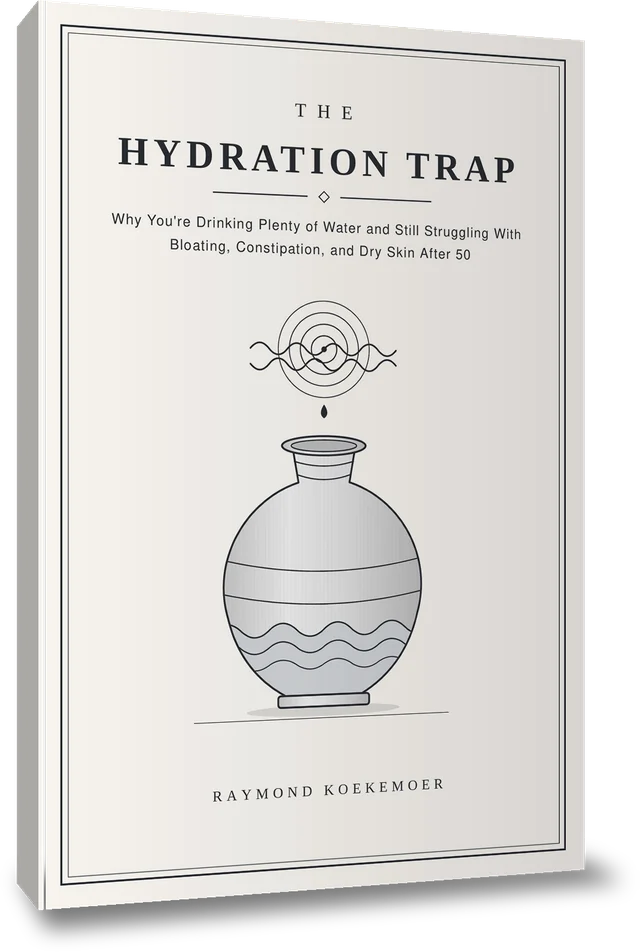
The Hydration Trap
Why You’re Drinking Plenty of Water and Still Struggling With Bloating, Constipation, and Dry Skin After 50
Kindle edition on Amazon Paperback on Amazon
Also available in Kindle Unlimited.
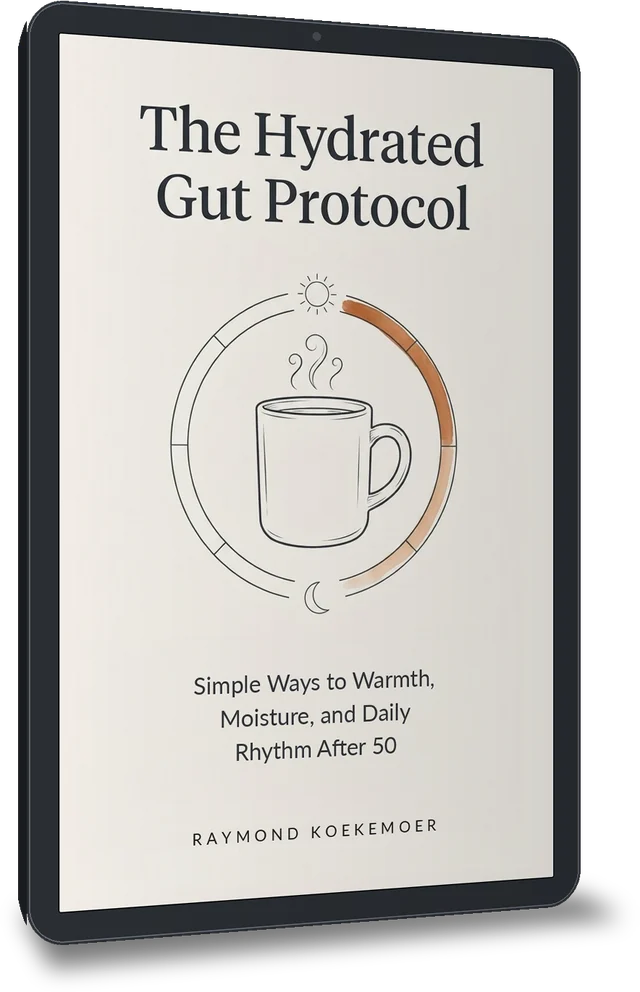
The Hydrated Gut Protocol
Simple Ways to Warmth, Moisture, and Daily Rhythm After 50
Coming soon to Apple Books, Kobo, Google Play Books, and other stores.